


Dental Cap vs Crown: Are They the Same? What You Need to Know

Updated: Aug 17
Dental cap vs crown: dental crown fitted over a prepared tooth

If your dentist has told you that you need a dental cap, you may hear the same treatment referred to as a dental crown. This can leave you wondering: are a dental cap and a dental crown actually different?
In most cases, they are not. Dental cap vs crown is a common question because “dental cap” and “dental crown” are two terms commonly used for the same type of restoration. A crown fits over a prepared tooth to restore its shape, strength, and function.
Dental Cap vs Crown: What Is the Difference?
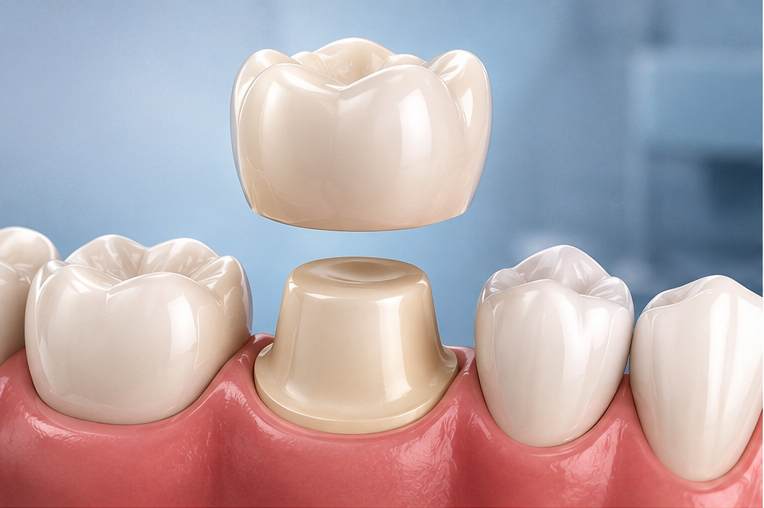
A dental crown is a restoration that fits over a prepared tooth. It is used to restore the tooth’s shape and function and can help protect a tooth that has been weakened or significantly damaged.
So, when someone says they need a dental cap, they are usually talking about a dental crown.
The more important question, however, is whether your tooth actually needs a crown. A damaged or decayed tooth does not automatically need one. In some cases, a filling or another type of restoration may be enough.
Your dentist will look at how much healthy tooth structure is left, where the tooth is located, how it has been damaged, and the amount of pressure it is exposed to when you bite and chew.
When Does a Tooth Actually Need a Crown?
A crown is generally considered when a tooth has lost a substantial amount of its natural structure and needs more support than a filling can provide.
Your dentist may recommend a crown when:
A large portion of the tooth has broken.
Extensive decay has weakened the tooth.
A large filling has left very little healthy tooth structure.
The tooth has a significant crack or is at risk of further damage.
The tooth needs additional protection after certain root canal treatments.
A severely worn tooth needs to be restored.
That does not mean every damaged tooth needs a crown. If there is enough healthy tooth structure remaining, your dentist may be able to restore it with a filling or another, more conservative option.
The aim is to choose a restoration that protects the tooth without removing more healthy tooth structure than necessary.
Crown or Filling: How Do You Decide?

One of the most common questions patients ask is, “Can I get a filling instead of a crown?”
Sometimes, you can.
If the damage is relatively small and the tooth still has enough healthy structure, a filling may be suitable. But when a large part of the tooth has been lost, a filling may not provide the support the tooth needs.
A crown covers the tooth and can provide additional protection when the remaining tooth structure is weak.
The decision is not based simply on the size of a cavity. Your dentist will consider the overall condition of the tooth, how much healthy structure remains, where the tooth is located, and how much chewing pressure it receives.
So, instead of assuming that a damaged tooth needs a crown, it is worth having the tooth examined first. In some cases, a less extensive restoration may be enough.
Do You Always Need a Crown After a Root Canal?
Not necessarily. Whether a tooth needs a crown after a root canal depends on the tooth itself and how much healthy structure remains.
Back teeth, such as molars, handle a lot of chewing pressure. If a molar has also lost a significant amount of its structure, your dentist may recommend a crown to provide additional protection.
Other teeth may sometimes be restored differently if enough healthy tooth structure remains.
Your dentist can assess the tooth and recommend the appropriate restoration based on its condition. If you want to learn more about the treatment itself, you can read about Root Canal Treatment before deciding on the next step.
Which Dental Crown Material Is Right for You?
Dental crowns are available in several materials. The right option depends on the tooth being treated, your bite, your aesthetic preferences, and the amount of strength the restoration needs.
Zirconia crowns are known for their strength and are often considered for teeth that experience regular chewing forces. They can also provide a natural-looking appearance.
Ceramic crowns can be a good option when appearance is an important consideration, particularly for visible teeth. They can be made to closely match the colour and shape of the surrounding teeth.
Porcelain-fused-to-metal crowns have a metal base with a tooth-coloured outer layer. They have been used for many years and may still be suitable for certain patients and teeth.
There is no single crown material that is right for everyone. Your dentist will consider the location of the tooth, your bite, the remaining tooth structure, and your cosmetic preferences before recommending a material.
Crown vs Veneer: What Is the Difference?

Crowns and veneers can both change the appearance of a tooth, but they are designed for different purposes.
A veneer is a thin covering that is bonded mainly to the front surface of a tooth. Veneers may be considered for cosmetic concerns such as tooth colour, shape, small chips, or minor gaps.
A crown covers a much larger portion of the tooth. It is generally considered when a tooth has been weakened, damaged, or has lost a significant amount of its natural structure.
This is why a veneer is not simply a thinner version of a crown. The two treatments are used in different situations.
If your main concern is the appearance of your teeth, you can learn more about Porcelain Veneers and whether they may be suitable for your smile.
What Does a Dentist Check Before Recommending a Crown?
Before recommending a crown, your dentist will first assess the condition of the tooth. The goal is to understand how much of the natural tooth can be preserved and what type of restoration will provide the appropriate support.
During an examination, your dentist may check:
How much natural tooth structure remains
Whether there is decay or a crack
The condition of the gums around the tooth
How your upper and lower teeth come together when you bite
Whether the tooth has had a root canal
Whether an X-ray is needed to assess the tooth and its roots
These factors help your dentist decide whether a crown is appropriate or whether another restoration may be a better choice.
At Silver Crest Dental Studio, digital scans and other dental technology may also be used during treatment planning when required. This can help the dental team assess the tooth and plan the restoration more precisely.
How Do You Know If a Crown Is Right for You?
There is no reliable way to know at home whether a tooth needs a crown. Two teeth can have similar-looking damage but require completely different treatments.
If a tooth is badly broken, has a large existing filling, has very little healthy structure left, or has become weakened after treatment, your dentist may recommend a crown.
On the other hand, if most of the natural tooth structure is still healthy, a filling or another restoration may be enough.
If a crown has been recommended, ask your dentist why it is needed and whether there are other suitable options. Understanding the condition of your tooth can make the treatment decision much easier.
Frequently Asked Questions
Is a dental cap the same as a crown?
Yes. In most cases, “dental cap” and “dental crown” refer to the same type of restoration. “Dental crown” is the term more commonly used in dentistry.
Is a crown always needed after a root canal?
No. The need for a crown depends on factors such as the type of tooth, how much healthy tooth structure remains, and how much stress the tooth is likely to experience. Your dentist can determine the most appropriate restoration after examining the tooth.
Is zirconia a type of dental cap?
Yes. Zirconia is one of the materials used to make dental crowns. It is known for its strength and can also provide a natural-looking result when appropriately selected.
Can a filling be used instead of a crown?
Sometimes. If enough healthy tooth structure remains, a filling may be suitable. If a tooth has lost a substantial amount of its structure, a crown may offer the additional support and coverage it needs.
Choosing the Right Treatment for Your Tooth
A dental crown can be an effective way to restore and protect a tooth that has been significantly damaged or weakened. However, it is not automatically the right choice for every damaged tooth.
The condition of the tooth should guide the decision. If your dentist has recommended a crown, ask what has made it necessary and whether a filling or another restoration could be suitable.
You can also discuss the available crown materials and which one would be appropriate for your particular tooth.
A dental examination gives you a much clearer picture of what your tooth needs than trying to decide based only on symptoms or information found online.
If you are considering a dental crown, you can book a consultation with Silver Crest Dental Studio in Defence Colony, Delhi to have your tooth assessed.
About Dr. Harris Bhandari
Dr. Harris Bhandari is part of the dental team at Silver Crest Dental Studio, a dental clinic in Defence Colony, New Delhi. Silver Crest combines clinical expertise with digital dentistry and personalised treatment planning.
Silver Crest Dental StudioE-20, First Floor, Defence Colony, New Delhi – 110024
Phone: 011-47029696
WhatsApp: +91 8510001229

Comments